
Development Matters statements, by area and age band.
All 307 statements from the Department for Education’s Development Matters, for the seven areas of learning: birth to 3, 3 and 4-year-olds, and children in reception. Search them, filter by age band and print.
Communication and language Prime area
Birth to 3
- Turn towards familiar sounds - they are also startled by loud noises and accurately locate the source of a familiar person’s voice, such as their key person or a parent
- Gaze at faces, copying facial expressions and movements like sticking out their tongue
- Make eye contact for longer periods
- Watch someone’s face as they talk
- Copy what adults do, taking ‘turns’ in conversations (through babbling) and activities
- Try to copy adult speech and lip movements
- Enjoy singing, music and toys that make sounds
- Recognise and are calmed by a familiar and friendly voice
- Listen and respond to a simple instruction
- Make sounds to get attention in different ways (for example, crying when hungry or unhappy, making gurgling sounds, laughing, cooing or babbling)
- Babble, using sounds like ‘baba’, ‘mamama’
- Use gestures like waving and pointing to communicate
- Reach or point to something they want while making sounds
- Copy your gestures and words
- Constantly babble and use single words during play
- Use intonation, pitch and changing volume when ‘talking’
- Understand single words in context – ‘cup’, ‘milk’, ‘daddy’
- Understand frequently used words such as ‘all gone’, ‘no’ and ‘bye-bye’
- Understand simple instructions like “give to nanny” or “stop”
- Recognise and point to objects if asked about them
- Generally focus on an activity of their own choice and find it difficult to be directed by an adult
- Listen to other people’s talk with interest but can easily be distracted by other things
- Make themselves understood and can become frustrated when they cannot
- Start to say how they are feeling, using words as well as actions
- Start to develop conversation, often jumping from topic to topic
- Develop pretend play - ‘putting the baby to sleep’ or ‘driving the car to the shops’
- Use the speech sounds p, b, m, w
- Pronounce: l/r/w/y; f/th; s/sh/ch/dz/j; multi-syllabic words such as ‘banana’ and ‘computer’
- Listen to simple stories and understand what is happening, with the help of the pictures
- Identify familiar objects and properties for practitioners when they are described, for example, ‘Katie’s coat’, ‘blue car’, ‘shiny apple’
- Understand and act on longer sentences like ‘make teddy jump’ or ‘find your coat’
- Understand simple questions about ‘who’, ‘what’ and ‘where’ (but generally not ‘why’)
3 and 4-year-olds
- Enjoy listening to longer stories and can remember much of what happens
- Pay attention to more than one thing at a time, which can be difficult
- Use a wider range of vocabulary
- Understand a question or instruction that has 2 parts, such as: “Get your coat and wait at the door”
- Understand ‘why’ questions, like: “Why do you think the caterpillar got so fat?”
- Sing a large repertoire of songs
- Know many rhymes, be able to talk about familiar books, and be able to tell a long story
- Develop their communication but may continue to have problems with irregular tenses and plurals, such as ‘runned’ for ‘ran’, ‘swimmed’ for ‘swam’
- Develop their pronunciation but may have problems saying: some sounds: r, j, th, ch, and sh; multi-syllabic words such as ‘pterodactyl’, ‘planetarium’ or ‘hippopotamus’
- Use longer sentences of 4 to 6 words
- Be able to express a point of view and to debate when they disagree with an adult or a friend, using words as well as actions
- Start a conversation with an adult or a friend and continue it for many turns
- Use talk to organise themselves and their play: “Let’s go on a bus… you sit there… I’ll be the driver”
Children in reception
- Understand how to listen carefully and why listening is important
- Learn new vocabulary
- Use new vocabulary throughout the day
- Ask questions to find out more and to check they understand what has been said to them
- Articulate their ideas and thoughts in well-formed sentences
- Connect one idea or action to another using a range of connectives
- Describe events in some detail
- Use talk to help work out problems and organise thinking and activities, and to explain how things work and why they might happen
- Develop social phrases
- Engage in storytimes
- Listen to and talk about stories to build familiarity and understanding
- Retell the story, once they have developed a deep familiarity with the text, some as exact repetition and some in their own words
- Use new vocabulary in different contexts
- Engage in non-fiction books
- Listen to and talk about selected non-fiction to develop a deep familiarity with new knowledge and vocabulary
- Listen carefully to rhymes and songs, paying attention to how they sound
- Learn rhymes, poems and songs
Physical development Prime area
Birth to 3
- Lift their head while lying on their front
- Push their chest up with straight arms
- Roll over: from front to back, then back to front
- Enjoy moving when outdoors and inside
- Sit without support
- Begin to crawl in different ways and directions
- Pull themselves upright and bouncing in preparation for walking
- Reach out for objects as co-ordination develops
- Pass things from one hand to the other, let go of things and hand them to another person, or drop them
- Gradually gain control of their whole body through the continual practice of large movements, such as: waving; kicking; rolling; crawling; walking
- Clap and stamp to music
- Fit themselves into spaces, like tunnels, dens and large boxes, and move around in them
- Enjoy starting to kick, throw and catch balls
- Build independently with a range of appropriate resources
- Begin to walk independently – choosing appropriate props to support at first
- Walk, run, jump and climb – and start to use the stairs independently
- Spin, roll and independently use ropes and swings (for example, tyre swings)
- Sit on a push-along wheeled toy, use a scooter or ride a tricycle
- Use large and small motor skills to do things independently, for example, manage buttons and zips, and pour drinks
- Show an increasing desire to be independent, such as wanting to feed themselves and dress or undress
- Start eating independently and learning how to use a knife and fork
- Develop manipulation and control
- Explore different materials and tools
3 and 4-year-olds
- Continue to develop their movement, balancing, riding (scooters, trikes and bikes) and ball skills
- Go up steps and stairs, or climb up apparatus, using alternate feet
- Skip, hop, stand on one leg and hold a pose for a game like musical statues
- Use large-muscle movements to wave flags and streamers, paint and make marks
- Start taking part in some group activities which they make up for themselves, or in teams
- Increasingly be able to use and remember sequences and patterns of movements which are related to music and rhythm
- Match their developing physical skills to tasks and activities in the setting, for example, they decide whether to crawl, walk or run across a plank, depending on its length and width
- Choose the right resources to carry out their own plan, for example, choosing a spade to enlarge a small hole they dug with a trowel
- Collaborate with others to manage large items, such as moving a long plank safely, carrying large hollow blocks
- Use one-handed tools and equipment, for example, making snips in paper with scissors
- Use a comfortable grip with good control when holding pens and pencils
- Show a preference for a dominant hand
- Be increasingly independent as they get dressed and undressed, for example, putting coats on and doing up zips
Children in reception
- Revise and refine the fundamental movement skills they have already acquired such as: rolling; crawling; walking; jumping; running; hopping; skipping; climbing
- Progress towards a more fluent style of moving, with developing control and grace
- Develop the overall body strength, coordination, balance and agility needed to engage successfully with future physical education sessions and other physical disciplines including dance, gymnastics, sport and swimming
- Develop their small motor skills so that they can use a range of tools competently, safely and confidently - suggested tools include: pencils for drawing and writing; paintbrushes; scissors; knives; forks; spoons
- Use their core muscle strength to achieve a good posture when sitting at a table or sitting on the floor
- Combine different movements with ease and fluency
- Confidently and safely use a range of large and small apparatus indoors and outside, alone and in a group
- Develop overall body strength, balance, coordination and agility
- Further develop and refine a range of ball skills including: throwing; catching; kicking; passing; batting; aiming
- Develop confidence, competence, precision and accuracy when engaging in activities that involve a ball
- Develop the foundations of a handwriting style which is fast, accurate and efficient
- Further develop the skills they need to manage the school day successfully such as lining up and queuing, and mealtimes
Personal, social and emotional development Prime area
Birth to 3
- Find ways to calm themselves, through being calmed and comforted by their key person
- Establish their sense of self
- Express preferences and decisions, they also try new things and start establishing their autonomy
- Engage with others through gestures, gaze and talk
- Use that engagement to achieve a goal, for example, gesture towards their cup to say they want a drink
- Find ways of managing transitions, for example, from their parent to their key person
- Thrive as they develop self-assurance
- Look back as they crawl or walk away from their key person
- Look for clues about how to respond to something interesting
- Play with increasing confidence on their own and with other children, because they know their key person is nearby and available
- Feel confident when taken out around the local neighbourhood and enjoy exploring new places with their key person
- Feel strong enough to express a range of emotions
- Grow in independence, rejecting help (“me do it”) - sometimes this leads to feelings of frustration and tantrums
- Begin to show ‘effortful control’, for example, waiting for a turn and resisting the strong impulse to grab what they want or push their way to the front
- Learn to use the toilet with help, and then independently
- Be increasingly able to talk about and manage their emotions
- Notice and ask questions about differences, such as skin colour, types of hair, gender, special needs and disabilities, religion and so on
- Develop friendships with other children
- Safely explore emotions beyond their normal range through play and stories
- Talk about their feelings in more elaborated ways: “I’m sad because…” or “I love it when …”
3 and 4-year-olds
- Select and use activities and resources, with help when needed - this helps them to achieve a goal they have chosen or one which is suggested to them
- Develop their sense of responsibility and membership of a community
- Become more outgoing with unfamiliar people, in the safe context of their setting
- Show more confidence in new social situations
- Play with one or more other children, extending and elaborating play ideas
- Find solutions to conflicts and rivalries, for example, accepting that not everyone can be Spider-Man in the game, and suggesting other ideas
- Increasingly follow rules, understanding why they are important
- Remember rules without needing an adult to remind them
- Develop appropriate ways of being assertive
- Talk with others to solve conflicts
- Talk about their feelings using words like ‘happy’, ‘sad’, ‘angry’ or ‘worried’
- Understand gradually how others might be feeling
- Be increasingly independent in meeting their own care needs, for example, brushing teeth, using the toilet, washing and drying their hands thoroughly
- Make healthy choices about food, drink, activity and toothbrushing
Children in reception
- See themselves as a valuable individual
- Build constructive and respectful relationships
- Express their feelings and consider the feelings of others
- Show resilience and perseverance in the face of challenge
- Identify and moderate their own feelings socially and emotionally
- Think about the perspectives of others
- Manage their own needs and personal hygiene
- Know and talk about the different factors that support their overall health and wellbeing including: regular physical activity; healthy eating; toothbrushing; sensible amounts of ‘screen time’; having a good sleep routine; being a safe pedestrian
Literacy Specific area
Birth to 3
- Enjoy songs and rhymes, tuning in and paying attention
- Join in with songs and rhymes, copying sounds, rhythms, tunes and tempo
- Say some of the words in songs and rhymes
- Copy finger movements and other gestures
- Sing songs and say rhymes independently, for example, singing whilst playing
- Enjoy sharing books with an adult
- Pay attention and respond to the pictures or the words
- Have favourite books and seek them out, to share with an adult, with another child, or to look at alone
- Repeat words and phrases from familiar stories
- Ask questions about the book, make comments and share their own ideas
- Develop play around favourite stories using props
- Notice some print, such as the first letter of their name, a bus or door number, or a familiar logo
- Enjoy drawing freely
- Add some marks to their drawings, which they give meaning to, for example: “That says mummy.”
- Make marks on their picture to stand for their name
3 and 4-year-olds
- Understand the 5 key concepts about print: print has meaning
- Understand the 5 key concepts about print: print can have different purposes
- Understand the 5 key concepts about print: we read English text from left to right and from top to bottom
- Understand the 5 key concepts about print: the names of the different parts of a book
- Understand the 5 key concepts about print: page sequencing
- Develop their phonological awareness, so that they can: spot and suggest rhymes; count or clap syllables in a word; recognise words with the same initial sound, such as money and mother
- Engage in extended conversations about stories, learning new vocabulary
- Use some of their print and letter knowledge in their early writing, for example, writing a pretend shopping list that starts at the top of the page, writing ‘m’ for mummy
- Write some or all of their name
- Write some letters accurately
Children in reception
- Read individual letters by saying the sounds for them
- Blend sounds into words, so that they can read short words made up of known letter– sound correspondences
- Read some letter groups that each represent one sound and say sounds for them
- Read a few common exception words matched to the school’s phonic programme
- Read simple phrases and sentences made up of words with known letter–sound correspondences and, where necessary, a few exception words
- Re-read these books to build up their confidence in word reading, their fluency and their understanding and enjoyment
- Form lower-case and capital letters correctly
- Spell words by identifying the sounds and then writing the sound with letters
- Write short sentences with words with known sound-letter correspondences using a capital letter and full stop
- Re-read what they have written to check that it makes sense
Mathematics Specific area
Birth to 3
- Combine objects like stacking blocks and cups - put objects inside others and take them out again
- Take part in finger rhymes with numbers
- React to changes of the amount in a group of up to 3 items
- Compare amounts, saying ‘lots’, ‘more’ or ‘same’
- Develop counting-like behaviour, such as making sounds, pointing or saying some numbers in sequence
- Count in everyday contexts, sometimes skipping numbers – ‘1-2-3-5’
- Climb and squeeze themselves into different types of spaces
- Build with a range of resources
- Complete inset puzzles
- Compare sizes, weights etc. using gesture and language - ‘bigger, little, smaller’, ‘high or low’, ‘tall’, ‘heavy’
- Notice patterns and arrange things in a pattern
3 and 4-year-olds
- Develop fast recognition of up to 3 objects, without having to count them individually (‘subitising’)
- Recite numbers past 5
- Say one number for each item in order: 1,2,3,4,5
- Know that the last number reached when counting a small set of objects tells you how many there are in total (‘cardinal principle’)
- Show ‘finger numbers’ up to 5
- Link numerals and amounts: for example, showing the right number of objects to match the numeral, up to 5
- Experiment with their own symbols and marks as well as numerals
- Solve real-world mathematical problems with numbers up to 5
- Compare quantities using language ‘more than’ and ‘fewer than’
- Talk about and explore 2D and 3D shapes (for example, circles, rectangles, triangles and cuboids) using informal and mathematical language such as: sides; corners; straight; flat; round
- Understand position through words alone, for example, “The bag is under the table,” with no pointing
- Describe a familiar route
- Discuss routes and locations, using words like ‘in front of’ and ‘behind’
- Make comparisons between objects relating to size, length, weight and capacity
- Select shapes appropriately such as flat surfaces for building or a triangular prism for a roof
- Combine shapes to make new ones, for example, an arch or a bigger triangle
- Talk about and identify the patterns around them, for example, stripes on clothes or designs on rugs and wallpaper
- Use informal language like ‘pointy’, ‘spotty’ or ‘blobs’
- Extend and create ABAB patterns – stick, leaf, stick, leaf
- Notice and correct an error in a repeating pattern
- Begin to describe a sequence of events, real or fictional, using words such as ‘first’, ‘then…’
Children in reception
- Count objects, actions and sounds
- Subitise
- Link the number symbol (numeral) with its cardinal number value
- Count beyond 10
- Compare numbers
- Understand the ‘one more than or one less than’ relationship between consecutive numbers
- Explore the composition of numbers to 10
- Automatically recall number bonds for numbers 0 to 5 and some to 10
- Select, rotate and manipulate shapes to develop spatial reasoning skills
- Compose and decompose shapes so that children recognise a shape can have other shapes within it, just as numbers can
- Continue, copy and create repeating patterns
- Compare length, weight and capacity
Understanding the world Specific area
Birth to 3
- Repeat actions that have an effect
- Explore materials with different properties
- Explore natural materials, indoors and outside
- Explore and respond to different natural phenomena in their setting and on trips
- Make connections between the features of their family and other families
- Notice differences between people
3 and 4-year-olds
- Use all their senses in hands-on exploration of natural materials
- Explore collections of materials with similar or different properties
- Talk about what they see, using a wide vocabulary
- Begin to make sense of their own life story and family’s history
- Show interest in different occupations
- Explore how things work
- Plant seeds and care for growing plants
- Understand the key features of the life cycle of a plant and an animal
- Begin to understand the need to respect and care for the natural environment and all living things
- Explore and talk about different forces they can feel
- Talk about the differences between materials and changes they notice
- Continue developing positive attitudes about the differences between people
- Know that there are different countries in the world and talk about the differences they have experienced or seen in photos
Children in reception
- Talk about members of their immediate family and community
- Name and describe people who are familiar to them
- Comment on images of familiar situations in the past
- Compare and contrast characters from stories, including figures from the past
- Draw information from a simple map
- Understand that some places are special to members of their community
- Recognise that people have different beliefs and celebrate special times in different ways
- Recognise some similarities and differences between life in this country and life in other countries
- Explore the natural world around them
- Describe what they see, hear and feel whilst outside
- Recognise some environments that are different from the one in which they live
- Understand the effect of changing seasons on the natural world around them
Expressive arts and design Specific area
Birth to 3
- Show attention to sounds and music
- Respond emotionally and physically to music when it changes
- Move and dance to music
- Anticipate phrases and actions in rhymes and songs, like ‘Peepo’
- Explore their voices and enjoy making sounds
- Join in with songs and rhymes, making some sounds
- Make rhythmical and repetitive sounds
- Explore a range of soundmakers and instruments and play them in different ways
- Enjoy and take part in action songs, such as ‘Twinkle, Twinkle Little Star’.
- Notice patterns with strong contrasts and be attracted by patterns resembling the human face
- Start to make marks intentionally
- Explore paint, using fingers and other parts of their bodies as well as brushes and other tools
- Express ideas and feelings through making marks, and sometimes give a meaning to the marks they make
- Start to develop pretend play, pretending that one object represents another, for example, a child holds a wooden block to her ear and pretends it’s a phone
- Explore different materials, using all their senses to investigate them
- Manipulate and play with different materials
- Use their imagination as they consider what they can do with different materials
- Make simple models which express their ideas
3 and 4-year-olds
- Take part in simple pretend play, using an object to represent something else even though they are not similar
- Begin to develop complex stories using small world equipment like animal sets, dolls and dolls houses
- Make imaginative and complex ‘small worlds’ with blocks and construction kits, such as a city with different buildings and a park
- Explore different materials freely, to develop their ideas about how to use them and what to make
- Develop their own ideas and then decide which materials to use to express them
- Join different materials and explore different textures
- Create closed shapes with continuous lines and begin to use these shapes to represent objects
- Draw with increasing complexity and detail, such as representing a face with a circle and including details
- Use drawing to represent ideas like movement or loud noises
- Show different emotions in their drawings and paintings, like happiness, sadness, fear
- Explore colour and colour mixing
- Show different emotions in their drawings – happiness, sadness, fear
- Listen with increased attention to sounds
- Respond to what they have heard, expressing their thoughts and feelings
- Remember and sing entire songs
- Sing the pitch of a tone sung by another person (‘pitch match’)
- Sing the melodic shape (moving melody, such as up and down, down and up) of familiar songs
- Create their own songs or improvise a song around one they know
- Play instruments with increasing control to express their feelings and ideas
Children in reception
- Explore, use and refine a variety of artistic effects to express their ideas and feelings
- Return to and build on their previous learning, refining ideas and developing their ability to represent them
- Create collaboratively, sharing ideas, resources and skills
- Listen attentively, move to and talk about music, expressing their feelings and responses
- Watch and talk about dance and performance art, expressing their feelings and responses
- Sing in a group or on their own, increasingly matching the pitch and following the melody
- Explore and engage in music making and dance, performing solo or in groups
- Develop storylines in their pretend play
Statements copied from Development Matters (Department for Education, September 2023 edition), non-statutory curriculum guidance for the EYFS in England. Contains public sector information licensed under the Open Government Licence v3.0. The statements are not a checklist: use them to understand children’s development and plan what to teach next.
Every statement, ready in the learning journal.
When a practitioner writes an observation, every Development Matters statement for the child’s age band is there to search and link, with the seven areas, the characteristics of effective learning and a next step.
See EYFS tracking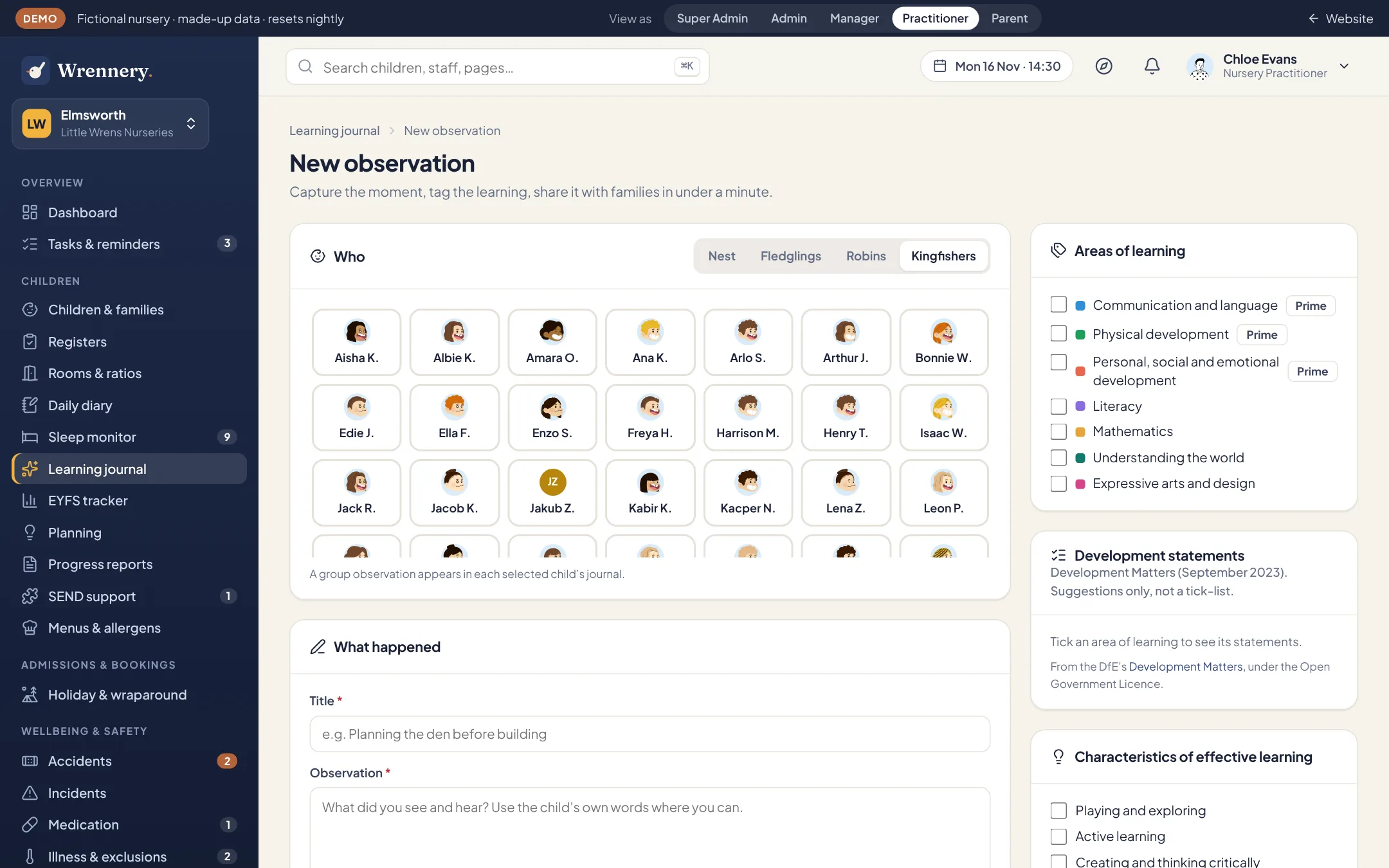
See it with your own nursery in mind.
Explore the full demo as a manager, practitioner, director, IT administrator or parent. No sign up, and no sales call.